


Table of Contents
- Dental Implant Insurance Coverage in British Columbia: What You Need to Know
- The Basics of Dental Implant Insurance Plans
- Medical Necessity vs. Cosmetic Classification for Implants
- Maximizing Your Implant Benefits: A Step-by-Step Guide
- Navigating Annual and Lifetime Maximums for Implant Coverage
- Common Questions About Dental Implant Insurance
- Take the Next Step with Northern Dental
Dental Implant Insurance Coverage in British Columbia: What You Need to Know
Now that you understand the basics of dental implants, it’s time to consider how to pay for them in British Columbia. Understanding dental implant insurance coverage in British Columbia is an important first step, as most private plans only cover a portion of the total treatment cost. At our practice in Dawson Creek, we believe in transparent pricing so you can make informed decisions about your smile without surprises.
Typical dental insurance for implants often includes annual maximums and may require a waiting period before you become eligible. Many plans classify implants as a major procedure, meaning they cover a percentage—often around 50%—up to a set limit each year. Without full coverage, patients may need to pay out-of-pocket or explore flexible alternatives. That’s why it’s so important to understand your specific implant insurance coverage before beginning treatment, so you know exactly what to expect financially.
If your insurance doesn’t cover the full cost, consider our dental implants payment plans in British Columbia designed to make treatment affordable and accessible. We offer in-house payment plans, coordinate with major BC insurance providers, and support third-party healthcare credit arrangements so you can spread the cost over manageable monthly payments. During your initial consultation, we’ll walk you through a detailed cost breakdown and help you select the best payment approach for your budget. Call us today to learn more—we’ve got all your dental needs covered under one roof.
The Basics of Dental Implant Insurance Plans
When exploring insurance for dental implants, understanding dental implant insurance coverage is the first step to making a confident decision. At our Dawson Creek practice, Northern Dental, we see patients every day who are surprised by how plan details can affect their out-of-pocket costs. Private and employer-sponsored plans handle implant procedures quite differently—let’s break down the key differences.
The following table compares typical coverage aspects between private and employer-sponsored dental insurance plans for implant procedures.
Coverage Percentage: Private plans generally cover about 50% of the approved implant cost, while many employer-sponsored plans pick up to 80% after you meet the deductible. This difference alone can mean thousands of dollars in savings, making employer coverage a valuable benefit when it’s available.
Annual Maximums: Private insurance typically caps reimbursement between $1,500 and $2,500 per year, whereas employer-sponsored plans often offer higher annual limits, from $2,000 to $3,500. For a procedure that can span multiple appointments, these ceilings play a big role in how much you’ll pay.
Waiting Periods: If you’ve just enrolled, be ready for a delay: private plans commonly require 12 to 24 months before covering major services like implants. Employer-sponsored plans tend to have shorter waiting periods—usually 6 to 12 months—so the clock starts ticking sooner.
Lifetime Maximums: Many private policies impose a separate lifetime maximum for implants (often $5,000 to $10,000), whereas employer-sponsored plans may not have a distinct lifetime cap, giving you more flexibility across multiple implant needs over the years.
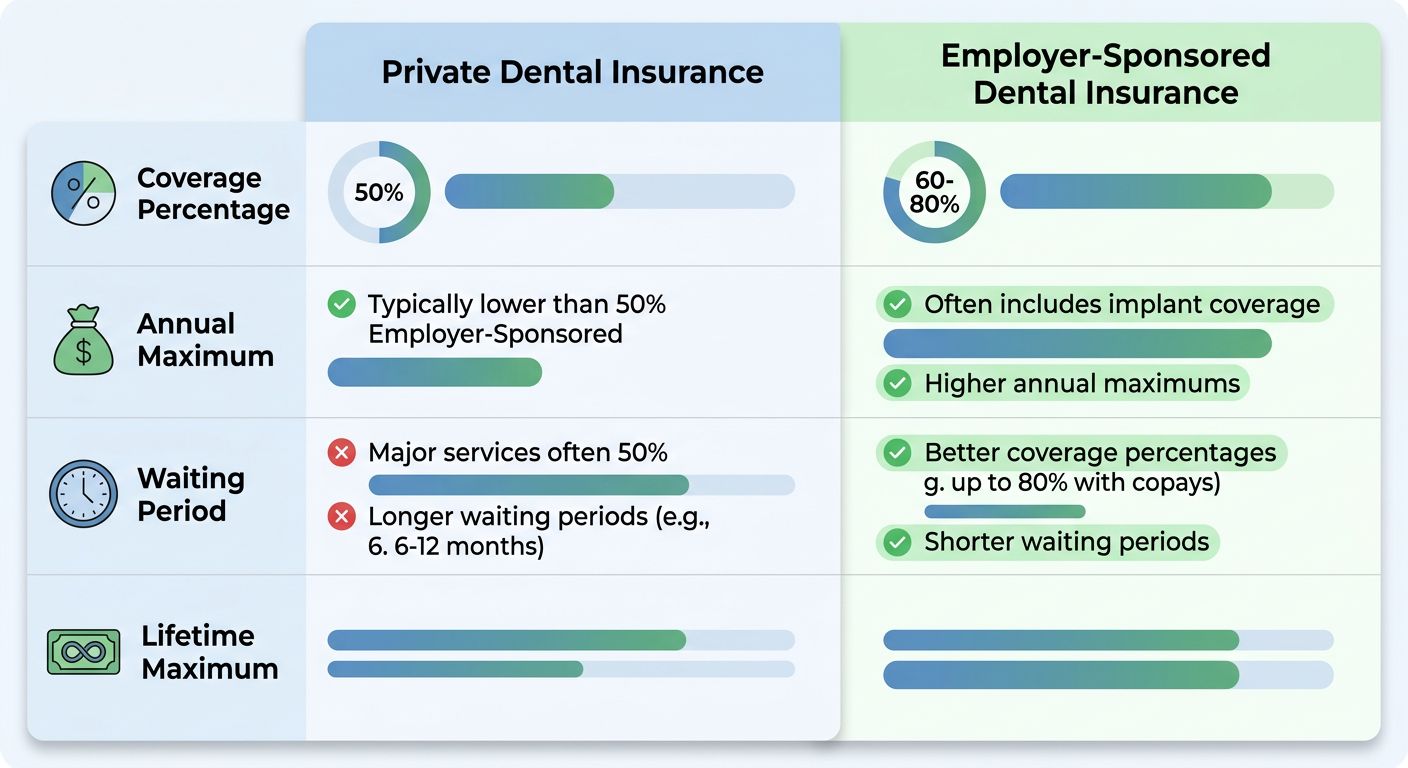
Private vs. employer-sponsored dental implant insurance coverage comparison
Seeing the numbers side by side helps you compare dental implant coverage options and ask the right questions when reviewing your own plan. At Northern Dental, we walk you through your specific coverage during a consultation, verifying benefits and even offering direct billing for participating insurers.
Remember, the details above are based on common BC plans and our practice’s experience; your exact coverage depends on your carrier and employer contract. Knowing these basics helps you compare plans and make an informed choice. Visit Us Today! to discuss how your insurance can support your implant treatment plan—and start smiling with confidence.
Medical Necessity vs. Cosmetic Classification for Implants
Understanding dental implant insurance coverage is the first step in navigating the financial side of restoring your smile. At Northern Dental, we want to help you understand how insurers look at your treatment plan, so you can make informed decisions and reduce unexpected costs. The key distinction insurers make is between procedures that are medically necessary and those that are considered purely cosmetic.
Understanding Medical Necessity for Dental Implants
When an insurance company reviews a claim for a dental implant, they look for proof of functional impairment, not just aesthetic preference. A procedure is deemed medically necessary when missing teeth prevent you from chewing food properly, cause significant bone loss in your jaw after an extraction, or lead to the shifting of adjacent healthy teeth. In these cases, coverage is often possible, provided you have the right documentation.
Strong clinical evidence is the foundation of a successful medical necessity claim. Our team compiles the clinical notes, diagnostic X-rays, and a written narrative that details how your oral function is compromised. When these documents clearly connect your implant to resolving a health issue, insurers may cover 50 to 80 percent of the procedure, depending on your specific policy. For example, maintaining your implant health with routine dental cleanings in Dawson Creek, British Columbia can help prevent complications that insurers may classify as medically necessary.
The following comparison table highlights the key differences:
| Coverage Aspect | Private Insurance | Employer-Sponsored Plan |
|---|---|---|
| Implant Coverage Percentage | Typically 50% of approved amount | Up to 80% after deductible |
| Annual Maximum | $1,500 – $2,500 | $2,000 – $3,500 |
| Waiting Period | 12-24 months for major services | 6-12 months |
| Lifetime Maximum | Often $5,000 – $10,000 | May have no separate lifetime max |
The table clearly shows that proving medical necessity is the most direct path to using your benefits. A claim justified by functional need not only accesses a higher coverage percentage but also ensures your annual maximum is applied where it counts most, whereas a cosmetic claim is typically denied outright without reducing your available benefits.
Common Insurance Exclusions and Limitations
Even with a strong medical necessity case, certain policy details can still affect your coverage. Many dental implant insurance coverage policies exclude treatment for teeth that were missing before the policy started, a rule known as a “missing tooth clause.” Other common limitations include waiting periods for major restorative services, which can range from six to twelve months, and annual maximums that often cap total benefits between $1,500 and $3,000 CAD.
It is also important to know that some plans classify all implant-related procedures as cosmetic by default, regardless of the medical reasons. The typical exclusions and limitations you might encounter include:
- Missing tooth clauses that deny coverage for pre-existing conditions
- Standard waiting periods before major services become eligible
- Annual maximum limits that may cap your implant coverage
- Policy language that broadly classifies implants as cosmetic
For instance, a policy might cover a crown on a damaged tooth but deny the implant post to replace a tooth that was extracted years ago. Understanding these fine-print details before you start treatment helps prevent surprise bills.
How to Request a Pre-Determination from Your Insurer
A pre-determination, also called a pre-treatment estimate, is the most reliable way to find out what your plan will pay. We strongly recommend this step for any implant treatment we believe is medically necessary. When evaluating your dental implant insurance coverage, a pre-determination gives you a clear financial picture before you commit to the procedure. Here is how the process works at Our Practice in Dawson Creek:
- Contact your insurance provider and request a pre-determination form for major dental services.
- Visit us for a comprehensive exam. We will capture the necessary diagnostic records, including X-rays and intraoral photos.
- We prepare a detailed treatment plan. This clinical narrative explains the functional necessity of your implant, linking it to your specific diagnosis and symptoms.
- We submit the claim package on your behalf, including the form, X-rays, clinical notes, and our narrative.
- You receive an estimate from your insurer outlining the approved amount, your co-pay percentage, and how it affects your annual maximum.
- We review the response together and finalize your treatment schedule and financial arrangements.
A key tip to remember is that a pre-determination is not a guarantee of payment, but it is a highly reliable estimate that helps you plan. Contact our Dawson Creek office for a coverage consultation — Visit Us Today!
Our team is dedicated to guiding you through this process, so you can move forward with confidence. We’ve got all your dental needs covered under one roof, from that first checkup to a fully restored, healthy smile.
Maximizing Your Implant Benefits: A Step-by-Step Guide
Maximizing your dental implant insurance coverage is the first step to affordable treatment. At Northern Dental, we guide you through the process. Now that you know how implants are placed, here’s how you can make the most of your benefits.
Checking Your Policy for Implant Coverage
Begin by locating your policy’s major restorative or prosthodontics section, where implant coverage details are usually found. Look for annual maximums — the total your insurer will pay per year — and any waiting periods that must pass before you’re eligible for implant benefits. Pre-authorisation is another critical step; many plans require it to confirm coverage before treatment starts.
The Canadian Dental Association recommends verifying all coverage parameters with your insurer directly. Call the number on your insurance card and ask specific questions about implant benefits, such as replacement limits and frequency clauses. If the language in your booklet is confusing, don’t worry — bring your policy to our Dawson Creek clinic. We’ll help you interpret it.
Actionable tip: request a pre-treatment estimate from your insurer. At Northern Dental, we can initiate this on your behalf. Knowing your potential out-of-pocket costs upfront eliminates surprises and lets you plan confidently. Even if your plan doesn’t fully cover implants, understanding your dental implant insurance coverage helps you plan a complementary payment method.
Working with Northern Dental for Streamlined Billing
Our team handles the paperwork so you can focus on your oral health. We offer direct billing: after your implant treatment, we submit the claim directly to your insurance provider, and many insurers reimburse us electronically. This significantly reduces your upfront expense and streamlines the process.
Before treatment, we provide a detailed pre-treatment estimate, showing exactly what your plan covers and what you’ll owe. We follow the latest guidelines from the Canadian Dental Association to ensure billing accuracy and maximize your benefits. We also coordinate with major British Columbia insurers, such as Pacific Blue Cross, to verify your implant benefits and submit any necessary documentation.
If your plan requires a narrative or additional forms, we manage those as well. Simply call us at (250) 782-3331 if you have questions about your insurer’s requirements. Our Practice in Dawson Creek is dedicated to making your insurance experience seamless.
Exploring Payment Plans and Financing Options
At Northern Dental, we offer several flexible payment options to make dental implants affordable. Here’s a quick comparison:
| Factor | Medically Necessary | Cosmetic |
|---|---|---|
| Coverage Percentage | 50-80% covered | Usually 0% coverage |
| Required Documentation | Clinical notes, X-rays, proof of functional impairment | No special documentation required, but claim denied |
| Pre-Determination | Strongly recommended | Optional, usually not approved |
| Impact on Annual Maximum | Uses benefits | Does not use benefits if denied |
Our in-house payment plan lets you spread costs over time, typically starting with a small deposit and no credit check, so it’s accessible for many budgets. Insurance billing is the easiest way to reduce immediate costs if your plan offers implant benefits, but always confirm your annual maximum. Health Savings Accounts offer tax-free savings, making them attractive if you’ve accumulated funds. Third-party financing can cover larger treatment fees with fast approval; however, interest rates vary, so compare carefully.
Which option fits you best? We’ll provide a transparent, upfront cost breakdown during your consultation and help you select the right path. Visit Us Today! to review your benefits and start your implant journey — our team at Our Practice in Dawson Creek is here to help.
Navigating Annual and Lifetime Maximums for Implant Coverage
In addition to understanding what your plan covers, it’s just as important to know how those coverage limits work. When you’re reviewing your dental implant insurance coverage, two types of maximums shape how much your plan will pay. The first is an annual maximum—a cap that typically falls between $1,500 and $3,000 per calendar year. According to the FAQs we share at our practice in Dawson Creek, this limit resets every year, so any unused portion does not carry forward. The second type is a lifetime maximum for implants, which can range from $5,000 to $15,000 and never resets.
The difference between these two caps matters because implant treatment often involves multiple steps that may span several months. An annual maximum may cover only a portion of the work each year, while a lifetime maximum sets a hard ceiling on the total your plan will contribute over the years you hold the policy. Northern Dental’s experience with common BC plan details shows that many patients hold both types of limits, so understanding how each works helps you avoid surprises later.
The comparison below summarizes the key differences between these two kinds of implant coverage limits.
| Option | Description | Pros | Cons |
|---|---|---|---|
| In-House Payment Plan | Monthly installments arranged through the clinic | Flexible terms, no credit check | May require deposit |
| Insurance Billing | Direct claim submission to your provider | Maximizes benefits, reduces out-of-pocket | Coverage dependent on plan |
| Health Savings Account (HSA) | Use pre-tax health spending dollars | Tax-free savings | Must have available funds |
| Third-Party Financing | Loans from specialized health lenders | Quick approval, high limits | Interest charges |
These dollar ranges reflect what we regularly see in the plans our Dawson Creek patients bring to us, so they represent realistic numbers rather than theoretical extremes. Because an annual maximum resets every January, a treatment plan that requires several implants often works best when we phase the work across two calendar years—placing the first implant late in one year and the next early in the following year. By contrast, a lifetime maximum doesn’t refresh, so if your plan sets that cap at, say, $10,000, every dollar the insurer pays for implants permanently reduces what remains available.
Now that you understand the difference between annual and lifetime maximums, you can better plan the timing of your implant treatment with our team. Visit Us Today! We’ve got all your dental needs covered under one roof. During your consultation, we’ll walk through your specific plan details and map out a schedule that makes the most of your implant coverage limits, so you can move forward with confidence.
Common Questions About Dental Implant Insurance
- Does my insurance cover dental implants? Coverage varies by plan, but many policies provide partial coverage for the surgery and abutment. The crown may also be partially covered under restorative benefits.
- What percentage of costs are typically covered? This depends entirely on your specific policy. We can help you submit a pre-treatment estimate to your provider to verify your exact benefits before we begin.
- How can I check my coverage? The best way is to contact your insurer directly or call us. Our team is experienced in working with most major plans, including Alberta Blue Cross and Sun Life.
- Are there waiting periods? Some plans do have waiting periods or specific exclusions, so it is always best to review your policy details.
We are committed to helping you maximize your insurance for dental implants and make informed decisions. Visit Us Today!
Take the Next Step with Northern Dental
Have questions about dental implant insurance coverage? Our friendly team is happy to walk you through your options. At Northern Dental, we’ve got all your dental needs covered under one roof, from cleanings to implants, right here at Our Practice in Dawson Creek.
We believe in open communication, family-focused care, and a preventive approach. We’re proud to be your local choice for comprehensive care in Dawson Creek. Call our friendly team today at (250) 782-3331 to book a visit. We follow the standards of the Canadian Dental Association. Visit Us Today!
Resources
- Explore Flexible Payment Plans for Dental Implants
- Get Full CDCP Coverage for Dental Implants
- Find Gentle Pediatric Dental Cleanings for Kids
- Get Same-Day Emergency Dental Services in Dawson Creek
- Get Professional Teeth Whitening with Safety Standards
- Get Long-Lasting Dental Implants for Tooth Replacement
- Find Financial Assistance Programs for Dental Implants
- Explore CDA Resources for Dental Professionals
